Before you open a Binance account: check region, ID and purpose
A sign-up can stall for reasons that have nothing to do with skill — for example, starting to fill in a form before deciding a few things. These three take two minutes and can save a whole round of rework.
In this article
- Region: it decides more than you think
- Document: will the one you have work
- Purpose: what do you actually want it for
- Two more things worth settling
- What you can ignore for now
- The email address deserves one minute of thought
- Decide the money question before the account exists
- How long each step takes
Region: it decides more than you think
The country dropdown on the sign-up form is not a statistics field. It determines which products the account can see, which features stay greyed out, and what standard your verification is assessed against.
You can land in one of three situations: fully open, partly open (you can register, but some product lines are unavailable), and not served (the option is missing, or the flow stops).
One rule not worth bending: answer truthfully. Some advice online suggests picking a different region to unlock things. The cost does not land on sign-up day; it lands when you try to take money out, because a mismatch between your details and your situation is the kind of thing a manual withdrawal review looks at. Getting your own assets stuck to avoid a small inconvenience is a bad trade.
A detail people miss: your region and the country that issued your document should be consistent with each other. Those two are read together in manual review, and a mismatch comes back as a vague rejection message that tells you nothing about the real cause.
You will not find a country list on this page. Rules change and platforms describe them differently, so any such list goes stale — and a stale list is more dangerous than none. Open the sign-up page and see whether your region is selectable, then check afterwards which features are marked unavailable.
Document: will the one you have work
Verification needs a document, and how smoothly it goes depends on which one and what state it is in.
- In date. Expired by a day is expired.
- The physical document — not a photocopy, not a picture of a screen. A photo of a screen invites moiré and glare, which makes the image hard to read.
- Name spelling must match what you typed. Middle names, transliteration order, hyphens: copy what is printed, do not improvise.
- All four corners, legible text. Do not shoot under a lamp that is directly overhead; light from the side leaves fewer hot spots.
If you have a passport, use it. One flat page, easy to frame completely, with a clear machine-readable zone, so there is less to get wrong when you photograph it. National ID cards need both sides, and a laminated surface can throw back glare.
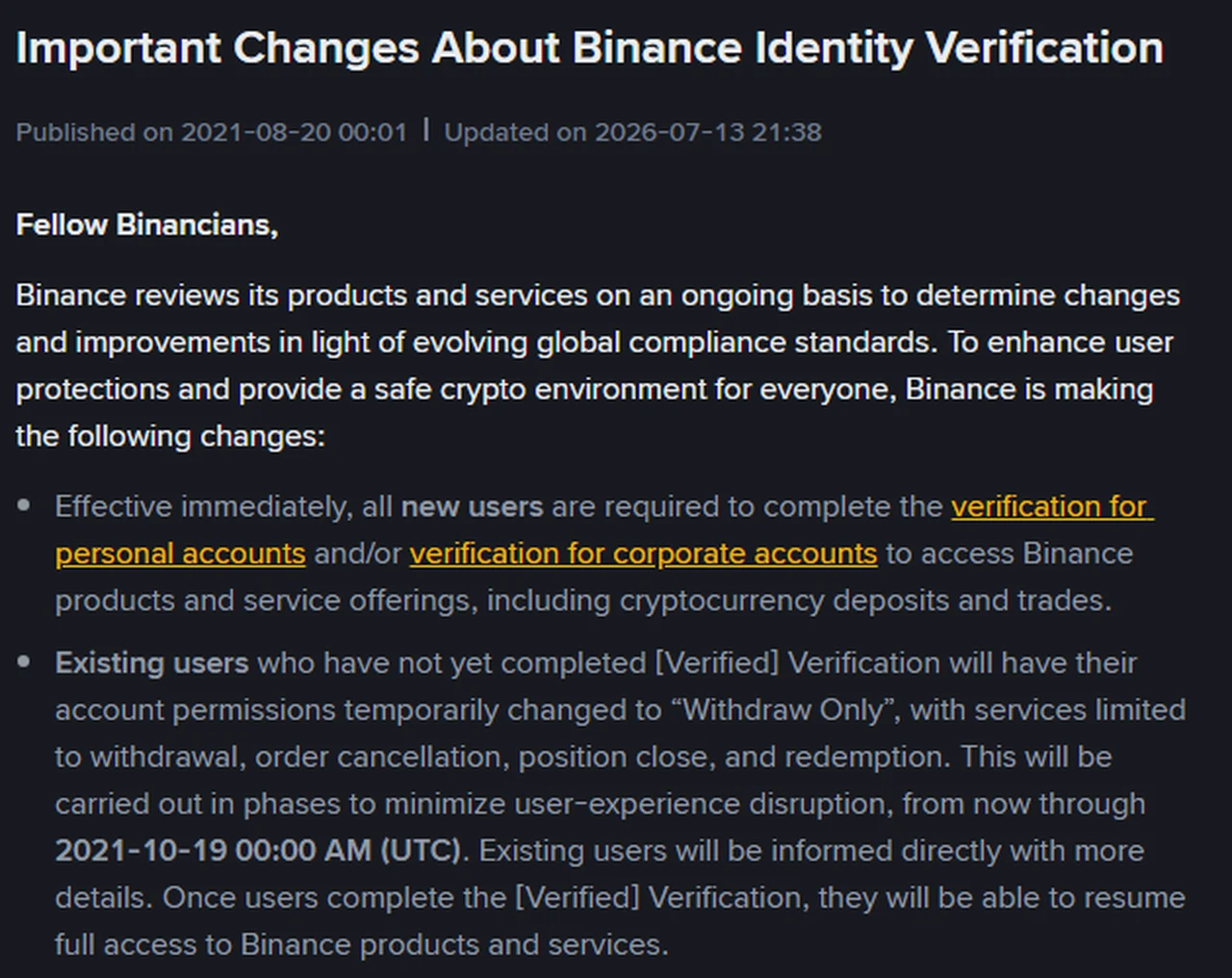
One thing that is easy to treat as optional: identity verification is not optional. Binance's announcement Important Changes About Binance Identity Verification and its help page on completing personal account verification are both blunt about it — every new user has to complete the level Binance labels [Verified] before they can use the platform's products and services, cryptocurrency deposits and trades included. Existing users who have not completed it have their account permissions temporarily changed to "Withdraw Only", limited to withdrawals, order cancellation, closing positions and redemption. Which is why two minutes on your document now beats stalling halfway through.
While you are preparing, do one more thing: find a spot with even light where you will not be interrupted for ten minutes. The face-check step restarts if you drop out, and repeated restarts make you impatient, which makes your photos worse. If it does stall, the verification article sorts the three failure modes.
Purpose: what do you actually want it for
This one sounds vague, but it decides how much you switch on.
If the goal is "learn to operate", you need very little: an account you can log into, plus eligibility for the demo environment. Futures permissions, margin, and the various earn products can all wait. Fewer features means a cleaner screen and fewer things to click by mistake.
Applying for everything available on day one because "it might be useful later" leaves you with a trading interface full of entry points you do not yet understand, which is a distraction during exactly the period when attention matters most. Leave them off; they can be enabled any time, and by then you will know why you want them.
There is a second layer: how much you intend to put in decides how much effort security deserves. For practice and small amounts, two-factor, a withdrawal whitelist and an anti-phishing code are enough (setup order here). For a sum that matters to you, start thinking about a dedicated device and a dedicated email address.
Two more things worth settling
Which device you will use
Verification wants a camera, which a phone has built in; day-to-day trading is easier to watch on a larger computer screen. If you plan to use both, decide in advance where the authenticator app lives and what happens if that device is lost.
That question takes a minute now and is a disaster later. The answer is simple: the backup key goes on paper, not in the notes app of the phone it protects.
How you will reach the site
Bookmark the real entry point before you start, and always arrive through the bookmark — not through search results, not through a link someone sent you.
Lookalike domains are convincing and the pages are copies; what you type goes to someone else. A bookmark you made yourself cannot be swapped out. Thirty seconds, and it closes off a mistake that can cost you the whole account.
What you can ignore for now
Having listed what to check, it is worth listing what not to worry about — beginners drown in concepts before they have an account.
- Which coin to buy: for practice, an actively traded major pair is fine. This is not a question that needs research yet.
- Whether to trade futures: the answer today is no. Revisit when spot feels routine.
- Earn products: unrelated to learning to operate.
- Moving assets on-chain: can wait until you actually hold something.
Spend the attention on "can I open an account and reach the demo environment". The rest is more efficiently learned when you genuinely need it.
The email address deserves one minute of thought
It is easy to skip this at sign-up and wish later that you had not. The address you register with becomes the anchor for everything: notices, recovery, and every piece of correspondence about the account.
Three properties are worth having:
- You will still control it in five years. A work address fails this the day you change jobs, and a school address fails on a fixed date.
- It is not the address you paste into every shopping site. Not because that leaks anything by itself, but because a mailbox with four hundred promotional messages a day is a mailbox where you will miss the one notice that mattered.
- It has its own strong password and its own two-factor. An email account that can be taken over is a route into everything the email can reset.
The same reasoning applies to the phone number, with one addition: numbers get recycled when you stop paying for them. If you are moving country, think about which number you will still answer a year from now.
Decide the money question before the account exists
This is not about how much to trade — that comes much later, and has its own article. It is about a question that is easier to answer honestly now, before an account exists and before anything is moving.
The question: is there an amount you could lose in full without anything in your life changing? Not "would I mind", but "would something break".
Answer it now for two reasons. The first is that the answer is more honest today than it will be after a fortnight of watching prices. The second is that if the honest answer is no, you have learned something useful for the price of two minutes: the practice route in the demo environment is still entirely open to you, costs nothing, and teaches the same operations. There is no rule that the practice has to end in a real trade.
Writing the number down somewhere also gives you something to check against later, when a number that felt reasonable in the moment turns out to be four times what you said.
How long each step takes
| Step | Roughly | What makes it longer |
|---|---|---|
| Checking region and document | A few minutes | Expired document, hunting for another one |
| Sign-up | A few minutes | Verification codes not arriving |
| Submitting ID | About ten minutes | Photos repeatedly rejected |
| Review | Unpredictable | Manual queues at busy times |
Only the last row is outside your control. The first three pass on the first attempt with decent preparation, and eat an afternoon without it — which is the whole argument for checking first.
With all three settled, go through the sign-up flow: the order and the places it snags are in the sign-up article.
"All new users are required to complete [Verified] to access Binance products and service offerings, including cryptocurrency deposits and trades" — that sentence is copied from the Binance help page on completing personal account verification, updated 2026-07-02 and read here in September 2026. The announcement in the screenshot above says the same thing in near-identical words; the "Withdraw Only" rule for existing accounts comes from the announcement. Which documents are accepted differs by country and region, and the same page says so.